SEARCH THIS WEBSITE
State of the art laser imaging, to provide remarkably detailed insight and reduce the need for a surgical biopsy.
Imagine receiving a detailed, real-time view beneath your skin without the need for an invasive biopsy. Reflectance confocal microscopy (RCM) offers exactly that – high-resolution cellular imaging that helps dermatologists diagnose skin cancer more accurately and quickly.
Key Areas We Will Cover
- What reflectance confocal microscopy (RCM) is and how it works
- Its benefits for diagnosing melanoma, basal cell, and squamous cell carcinoma
- How RCM reduces the need for surgical biopsies
- Applications in treatment monitoring and complex cases
- Access to advanced confocal microscopy at UK dermatology clinics
Introduction
Confocal microscopy, particularly reflectance confocal microscopy (RCM), is a state-of-the-art noninvasive imaging technology that allows dermatologists to examine skin at a cellular level in real time. This innovative tool is transforming skin cancer diagnosis by providing detailed insights without traditional biopsies in many cases. At The Skin Care NetworkF, our dermatologists utilise this advanced technology to deliver precise, patient-friendly care for residents across London and Hertfordshire.
What Is Reflectance Confocal Microscopy (RCM) and How Does It Work?
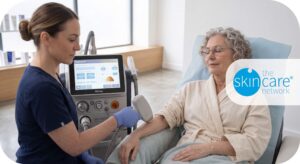
Reflectance confocal microscopy (RCM) uses a safe laser beam to create high-resolution, real-time images of skin layers below the surface.
The handheld device captures cellular details similar to those seen under a traditional microscope, enabling quick, noninvasive optical biopsies. It is painless, requires no downtime, and is ideal for sensitive or hard-to-reach areas.
How Accurate Is Confocal Microscopy for Skin Cancer Detection?
RCM provides excellent diagnostic accuracy for various skin cancers, including melanoma, basal cell carcinoma, and squamous cell carcinoma.
It excels at identifying subtle features in early or ambiguous lesions, often reducing unnecessary excisions while ensuring suspicious cases receive prompt attention.
Can Confocal Microscopy Reduce the Need for Invasive Biopsies?
Yes. RCM frequently serves as an optical biopsy, offering immediate results without cutting the skin.
This minimises discomfort, scarring, and waiting times compared to conventional histology, although a traditional biopsy may still be required in some complex cases.
How Does RCM Assist in Melanoma Diagnosis and Monitoring?
Early detection of melanoma is critical, and RCM helps identify hard-to-diagnose cases that might be missed by visual examination alone.
It is also valuable for post-treatment monitoring, allowing dermatologists to assess response without repeated invasive procedures.
Who Benefits Most from Confocal Microscopy at a Dermatology Clinic?
Patients with suspicious moles, a history of skin cancer, or lesions in cosmetically sensitive areas benefit significantly.
A dermatologist can determine when RCM is appropriate during your consultation, combining it with clinical expertise for the best outcomes.
Where Can You Access Confocal Microscopy in the UK?
This advanced technology remains relatively rare but is available at leading private dermatology clinics. The Skin Care Network was among the first to offer it in a private setting.
Conclusion
Confocal microscopy represents a major advancement in dermatology, offering noninvasive, real-time cellular imaging that enhances skin cancer detection and patient experience. By reducing biopsies and supporting expert diagnosis, it helps achieve earlier intervention and better results. Combined with the skill of a dermatologist, this technology provides reassurance and effective care.
Get Started Today
Ready to benefit from advanced skin cancer diagnostics? Book a consultation with a dermatologist at The Skin Care Network. Call +44 20 8441 1043 or visit our Barnet clinic at 68-70 Union St, Barnet EN5 4HZ, United Kingdom, for expert assessment using cutting-edge tools like confocal microscopy.
Frequently Asked Questions
This FAQ section answers common questions about confocal microscopy to help you understand its role in modern skin cancer care.
Yes. It uses a safe laser and is completely noninvasive, with no radiation or significant side effects.
It often reduces the need for biopsies but may be combined with traditional methods when further confirmation is required.
The procedure is quick, usually taking just a few minutes, with immediate results available for review.
Absolutely. It is particularly useful for evaluating suspicious moles and early melanoma detection.
Consult a dermatologist at The Skin Care Network by calling +44 20 8441 1043. Our specialists will advise if RCM is right for your needs.