SEARCH THIS WEBSITE

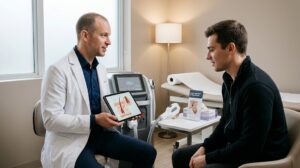
Did you know that starting laser hair removal early in mild-to-moderate pilonidal disease can help more than 80% of patients avoid surgery, while achieving recurrence rates comparable to more invasive approaches? Excess hair in the natal cleft is a key driver of pilonidal sinus formation and recurrence. A Dermatologist can assess suitability and deliver targeted laser epilation as part of a conservative management plan.
“Upfront laser epilation achieved recurrence outcomes comparable to an upfront Gips procedure followed by adjunctive laser treatment.”
Key Areas We Will Cover
- What pilonidal disease is and why hair plays a central role
- Evidence that early laser epilation can reduce the need for surgery
- How laser hair removal works in this condition
- What to expect from a course of treatment
- Who is a suitable candidate
- The importance of Dermatologist-led care in the UK
What Is Pilonidal Disease?
Pilonidal disease (also called pilonidal sinus disease) is a chronic condition that occurs in the cleft at the top of the buttocks.
Loose or growing hairs become embedded in the skin, creating pits or sinuses that can become inflamed, infected or form abscesses. It most commonly affects adolescents and young adults, particularly those with denser body hair. Recurrence after surgery is relatively common, which is why strategies that address the underlying hair are increasingly important.
How Can Upfront Laser Epilation Help Patients Avoid Surgery?
Recent evidence shows that starting laser hair removal early, before or instead of surgery in selected mild-to-moderate cases, allows a high proportion of patients to avoid operative intervention.
In a retrospective study of adolescents and young adults presented in 2026, more than 80% of those treated with upfront laser epilation avoided surgery while achieving recurrence outcomes similar to patients who had surgery plus laser. Other studies and meta-analyses support laser epilation (alone or as an adjunct) in reducing recurrence by removing the hairs that drive the disease process.
Why Does Removing Hair Make Such a Difference?
Hairs in the natal cleft act as a persistent source of irritation and infection.
When laser energy damages the hair follicles, both the number and thickness of hairs decrease. This reduces the chance of new hairs penetrating the skin, allowing existing inflammation and small sinuses to settle. Greater degrees of hair reduction are associated with lower recurrence rates. Treatment is typically continued until a substantial and stable reduction in hair is achieved rather than for a fixed number of sessions.
What Does Laser Treatment Involve?
A Dermatologist selects an appropriate laser wavelength and settings based on skin type and hair characteristics.
Modern dual-wavelength platforms can treat a wide range of skin tones safely. Sessions are usually spaced several weeks apart. Most patients need a course of treatments (commonly in the range of 6–10) to reach meaningful, lasting hair reduction in the natal cleft. The procedure is performed in clinic with cooling for comfort and involves minimal downtime. You can learn more about available systems on our pages covering laser hair removal and the Splendor X laser.
Who Is a Suitable Candidate for Early Laser Treatment?
Laser epilation is particularly useful for:
- Mild-to-moderate pilonidal disease without large abscesses or complex branching sinuses
- Patients wishing to avoid or delay surgery
- Those who have already had surgery and want to reduce the risk of recurrence
- Individuals with significant hair growth in the natal cleft
A thorough assessment by a Dermatologist determines whether laser can be used as a primary approach or as an adjunct to other care. More severe or acutely infected cases may still require surgical input first.
Why Choose Dermatologist-Led Laser Treatment?
Accurate diagnosis, appropriate laser selection and realistic goal-setting are essential for good outcomes.
A Dermatologist can confirm the stage of disease, exclude other conditions, choose the safest and most effective laser parameters for your skin and hair type, and integrate laser into an overall management plan. Ongoing review ensures treatment continues until the desired hair reduction and clinical improvement are achieved.
At The Skin Care Network, located at 68-70 Union St, Barnet EN5 4HZ, United Kingdom, our consultant Dermatologists provide expert assessment and laser hair removal for pilonidal disease and related concerns. Call +44 20 8441 1043 to book a consultation. Further information on how laser helps prevent recurrence is also available on our dedicated pilonidal sinus and laser page.
Conclusion
Excess hair is a central factor in the development and recurrence of pilonidal disease. Growing evidence shows that starting laser epilation early in mild-to-moderate cases can help many patients avoid surgery while delivering recurrence rates comparable to more invasive pathways. When performed by a Dermatologist using appropriate technology, laser hair removal offers a well-tolerated, evidence-based option that addresses the root cause rather than only the symptoms.
Get Started Today
Living with pilonidal disease or concerned about recurrence after surgery? Book a consultation with a Dermatologist at The Skin Care Network to discuss whether laser hair removal is a suitable option for you.
Frequently Asked Questions
This FAQ section answers common questions about laser treatment for pilonidal disease, supporting informed decisions with guidance from a Dermatologist.
In selected mild-to-moderate cases, studies show that upfront laser epilation allows a substantial proportion of patients (over 80% in one recent series) to avoid surgical intervention while achieving good control of the disease.
Most patients require a course of treatments, often in the region of 6–10 sessions, spaced several weeks apart, until significant and stable hair reduction is achieved.
Modern lasers incorporate cooling systems to improve comfort. Most people describe the sensation as tolerable, and any discomfort is brief.
Yes. Laser hair removal is frequently used as an adjunct after surgery to lower the risk of recurrence by permanently reducing hair in the natal cleft.
A Dermatologist experienced in both the medical aspects of pilonidal disease and laser hair removal can determine suitability and supervise the course of treatment.
Details of our laser hair removal services and technology are available on the excess hair removal and Splendor X pages.