SEARCH THIS WEBSITE
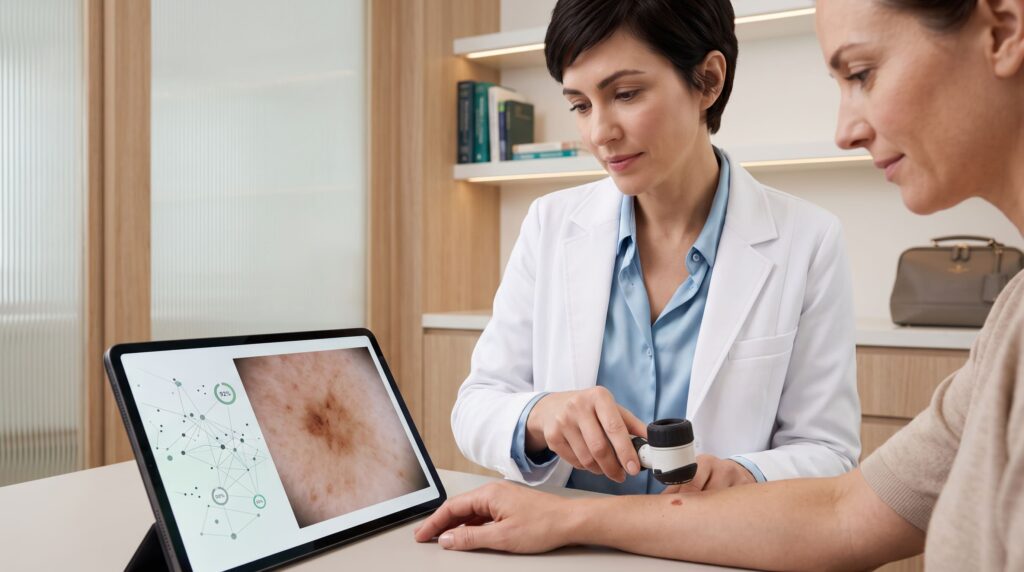
Did you know that while artificial intelligence can match or even improve certain aspects of dermoscopic skin-cancer detection, the best results occur when AI works alongside an experienced Dermatologist rather than replacing one? Recent reviews confirm that expert oversight remains essential to avoid overdiagnosis, address gaps in training data, and ensure safe patient care.
Key Areas We Will Cover
- How dermoscopy and AI have improved skin-cancer detection
- What current evidence shows about AI versus Dermatologist performance
- The added value of AI-assisted specialist assessment
- Important limitations of current AI systems
- Why expert oversight continues to matter
- Practical advice for patients in the UK
Introduction
Dermoscopy, introduced widely in the 1990s, improved diagnostic accuracy, supported earlier detection of skin cancer and reduced unnecessary biopsies compared with naked-eye examination alone. Artificial intelligence tools trained on dermoscopic images now offer the potential to enhance performance further. However, a growing body of evidence stresses that AI works best as a support tool under the supervision of a trained Dermatologist. This article summarises the current position and explains why human expertise remains central. At The Skin Care Network our consultant Dermatologists combine clinical experience, dermoscopy and, where appropriate, emerging technologies to deliver accurate assessment.
How Has AI Performed Alongside Dermoscopy?
Meta-analyses show that AI alone can achieve sensitivity and specificity broadly comparable to dermatologists for melanoma detection on dermoscopic images.
Pooled figures from recent analyses place dermatologists at approximately 79 % sensitivity and 75 % specificity, with AI systems performing in a similar range. In the limited data available for AI-assisted dermatologists, performance rose further (one study reported sensitivity of around 92 % and specificity of 84 %). AI has also shown promise in triage settings, helping to identify lesions that do not require urgent referral or biopsy and potentially reducing healthcare costs.
What Are the Main Limitations of Current AI Systems?
Several important constraints limit the readiness of AI to operate independently.
Prospective real-world evidence remains relatively limited. Many algorithms have been trained on datasets that under-represent skin of colour, leading to reduced accuracy in diverse populations. Reporting of demographic diversity in studies is often incomplete. Ethical issues around data security, regulation and the risk of over-reliance also persist. When AI is used without specialist oversight it can show higher sensitivity but lower specificity, raising the possibility of overdiagnosis and unnecessary procedures.
Why Does Expert Oversight by a Dermatologist Still Matter?
A Dermatologist brings clinical context, full-skin examination, patient history and judgement that pure image-based AI cannot replicate.
AI analyses individual lesions or patterns but does not automatically integrate risk factors, the “ugly duckling” comparison across a patient’s other moles, or the subtleties of an in-person assessment. Experienced specialists consistently outperform AI in complex, real-world multiclass diagnosis. The optimal model is therefore collaborative: AI can flag lesions, support triage or provide a second read, while the Dermatologist retains final responsibility for diagnosis and management decisions.
How Is AI Being Used in Practice Today?
In the UK and elsewhere, regulated AI tools are beginning to assist with triage and decision support.
Devices that have achieved appropriate regulatory status can help primary-care clinicians or teledermatology services prioritise lesions. Within specialist clinics, AI may be incorporated into total-body photography systems or used as an adjunct during dermoscopy. In all these settings the technology functions best when a Dermatologist interprets the output and makes the final clinical decision.
What Should Patients Know When Considering AI Tools?
Consumer apps and online AI checkers vary widely in quality and regulation.
They may raise awareness but should not replace professional assessment. Any concerning lesion new, changing, symptomatic or simply worrying warrants evaluation by a Dermatologist who can use dermoscopy and, if needed, arrange biopsy. AI may one day form part of that specialist workflow, but expert oversight remains the safeguard for accuracy and safety.
At The Skin Care Network, located at 68-70 Union St, Barnet EN5 4HZ, United Kingdom, our consultant Dermatologists provide thorough skin-cancer assessment using clinical examination and dermoscopy. Call +44 20 8441 1043 to book an appointment or discuss any skin concerns.
Conclusion
Artificial intelligence applied to dermoscopy offers genuine promise for improving diagnostic performance, supporting triage and reducing unnecessary biopsies. Evidence shows that the strongest results occur when AI assists rather than replaces a Dermatologist. Limitations in dataset diversity, prospective validation and real-world generalisability mean that expert oversight continues to be essential. For patients, the message is clear: technology can enhance care, but the judgement of a trained Dermatologist remains central to safe and accurate skin-cancer diagnosis.
Get Started Today
Concerned about a mole or skin lesion, or interested in specialist assessment that combines experience with modern tools? Book a consultation with a Dermatologist at The Skin Care Network for expert evaluation and personalised advice.
Frequently Asked Questions
This FAQ section answers common questions about AI in dermoscopy and the continuing importance of specialist care, supporting informed decisions with guidance from a Dermatologist.
No. Current evidence supports AI as a decision-support tool. Attempts to use AI alone risk lower specificity and overdiagnosis. The best outcomes occur when a Dermatologist interprets AI findings within the full clinical context.
In controlled studies AI can match average dermatologist performance on binary melanoma versus non-melanoma tasks. Experienced specialists often outperform AI in real-world, multiclass diagnosis, and AI-assisted dermatologists have shown the highest figures in available data.
Quality and regulation vary. Many consumer apps lack robust clinical validation or diverse training data. They should not be relied upon for diagnosis; any concerning lesion needs professional assessment.
We prioritise clinical examination and dermoscopy by consultant Dermatologists. Emerging validated tools may be incorporated as supportive aids under specialist oversight when they demonstrably improve patient care.
Arrange an appointment with a Dermatologist. Full clinical assessment, dermoscopy and, when indicated, biopsy remain the gold-standard pathway for accurate diagnosis.