SEARCH THIS WEBSITE
Did you know that international experts have reached clear consensus on when advanced imaging techniques such as total body photography and serial digital dermoscopy should be used to detect melanoma earlier? These tools help monitor high-risk patients and equivocal lesions without unnecessary biopsies, but they are not needed for everyone. Understanding the recommendations allows patients and clinicians to use them appropriately.
Key Areas We Will Cover
- What total body photography and serial dermoscopy involve
- Consensus recommendations for when total body photography is indicated
- When serial digital dermoscopic imaging is most useful
- How these techniques complement specialist assessment
- Practical implications for UK patients
- How The Skin Care Network applies these approaches
Introduction
Noninvasive imaging techniques play an increasing role in the early detection of melanoma, particularly in people at elevated risk. Total body photography (TBP), serial digital dermoscopic imaging (SDDI) and, in selected cases, reflectance confocal microscopy help track changes over time and reduce unnecessary procedures. An international group of dermato-oncologists used a formal Delphi process to develop consensus recommendations on the appropriate use of these tools. This article summarises the key points in plain language and explains how they guide care. At The Skin Care Network we incorporate these evidence-based approaches into our mole-mapping and surveillance programmes.
What Is Total Body Photography?
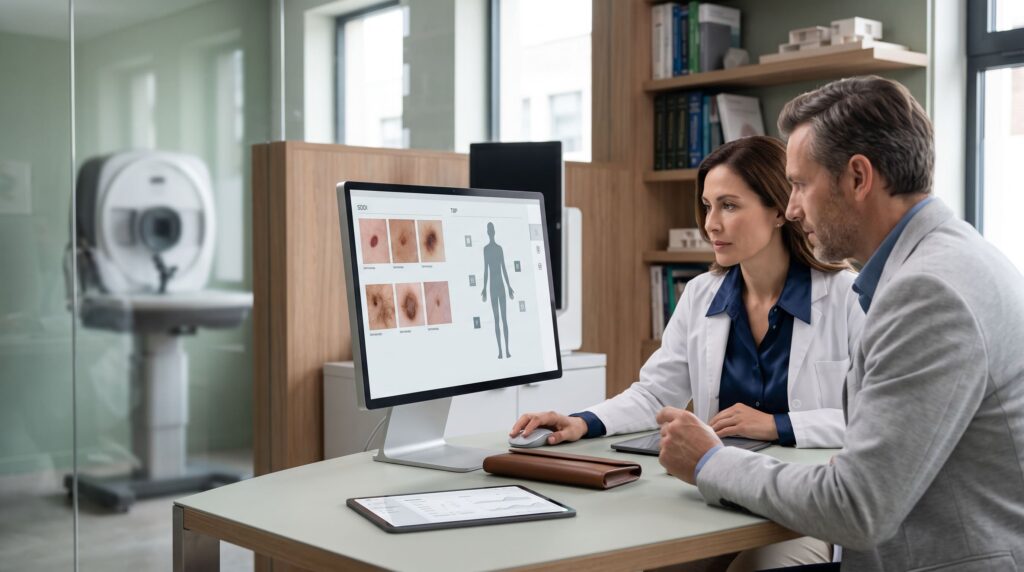
Total body photography creates a comprehensive baseline set of images of the entire skin surface.
These photographs allow a Dermatologist to compare the skin at future visits and identify new or changing lesions that might otherwise be missed, especially in patients with many moles. Once baseline images exist, new photographs are taken only when the previous set is no longer easily comparable to the patient’s current appearance.
When Is Total Body Photography Recommended According to Consensus?
Expert consensus supports TBP in specific higher-risk situations.
Total body photography is recommended for patients with familial atypical multiple mole melanoma (FAMMM) syndrome, also known as dysplastic naevus syndrome.
It is also recommended in adults who have more than 50 naevi plus one or more of the following:
- A personal history of multiple cutaneous melanomas
- A personal history of amelanotic melanoma
- Multiple pink naevi
- Multiple clinically atypical naevi
- A genetic syndrome that predisposes to melanoma
TBP is generally not recommended for all patients simply because they have more than 50 moles if none of the additional risk factors are present, nor for children in most circumstances because of the natural volatility of childhood moles and their overall low melanoma risk.
When Is Serial Digital Dermoscopic Imaging Recommended?
Serial digital dermoscopic imaging is particularly useful for monitoring individual lesions that are not clearly benign or malignant.
Consensus supports its use for “ugly duckling” naevi that show equivocal dermoscopic features. It is also recommended for large or growing lentigo-like lesions that lack definitive dermoscopic features of malignancy, with planned re-evaluation typically at a 3- to 6-month interval.
Lesions with obviously malignant dermoscopic features should be biopsied rather than monitored. Serial imaging can be used alone or together with total body photography.
How Do These Techniques Help Patients?
The main benefits are earlier detection of melanoma and fewer unnecessary biopsies.
By establishing a photographic baseline and tracking subtle change, these methods allow a Dermatologist to intervene at the earliest opportunity while avoiding removal of stable, benign lesions. They are especially valuable for people with numerous or atypical moles, previous melanoma, or significant anxiety about their skin.
How Does The Skin Care Network Use These Approaches?
We offer structured mole-mapping and digital monitoring aligned with current expert recommendations.
Our service includes total body photography and sequential digital dermoscopy for patients who meet appropriate criteria. Full details of our mole-mapping programme are available here: Mole Mapping at The Skin Care Network.
A consultant Dermatologist assesses individual risk, explains whether imaging is indicated, and designs a personalised surveillance plan.
At The Skin Care Network, located at 68-70 Union St, Barnet EN5 4HZ, United Kingdom, our team provides these advanced monitoring techniques as part of comprehensive skin-cancer care. Call +44 20 8441 1043 to discuss whether total body photography or serial dermoscopy may be suitable for you.
Conclusion
International consensus provides clear guidance on when total body photography and serial digital dermoscopic imaging add most value. These techniques are recommended for defined higher-risk groups and for monitoring selected equivocal lesions, rather than for every patient with multiple moles. Used appropriately, they support earlier melanoma detection and more selective use of biopsy. A Dermatologist can determine whether these tools are indicated in your individual case and integrate them into a tailored surveillance plan.
Get Started Today
Wondering whether total body photography or serial mole monitoring is appropriate for you? Book a consultation with a Dermatologist at The Skin Care Network to review your risk profile and discuss the options, including our dedicated mole-mapping service.
Frequently Asked Questions
This FAQ section answers common questions about total body photography and serial dermoscopy, helping you understand when these techniques are recommended with guidance from a Dermatologist.
Not necessarily. Consensus recommends it when there are more than 50 naevi plus additional risk factors such as previous melanomas, multiple atypical or pink naevi, or a predisposing genetic syndrome. A Dermatologist will assess whether it is indicated for you.
New images are obtained when the previous set is no longer easily comparable to the patient’s current skin appearance, rather than on a fixed annual schedule.
It is a mole that looks different from the person’s other moles. When such a lesion also shows equivocal features under dermoscopy, serial digital imaging is often recommended to monitor for change.
No. Lesions with clearly malignant features still require biopsy. Imaging helps decide which lesions can be safely monitored and which need immediate sampling.
It is a specialised tool used in selected centres for equivocal lesions, particularly in cosmetically sensitive sites or when patients prefer to avoid immediate biopsy. Availability varies; your Dermatologist can advise if it is relevant in your case.