 SEARCH THIS WEBSITE
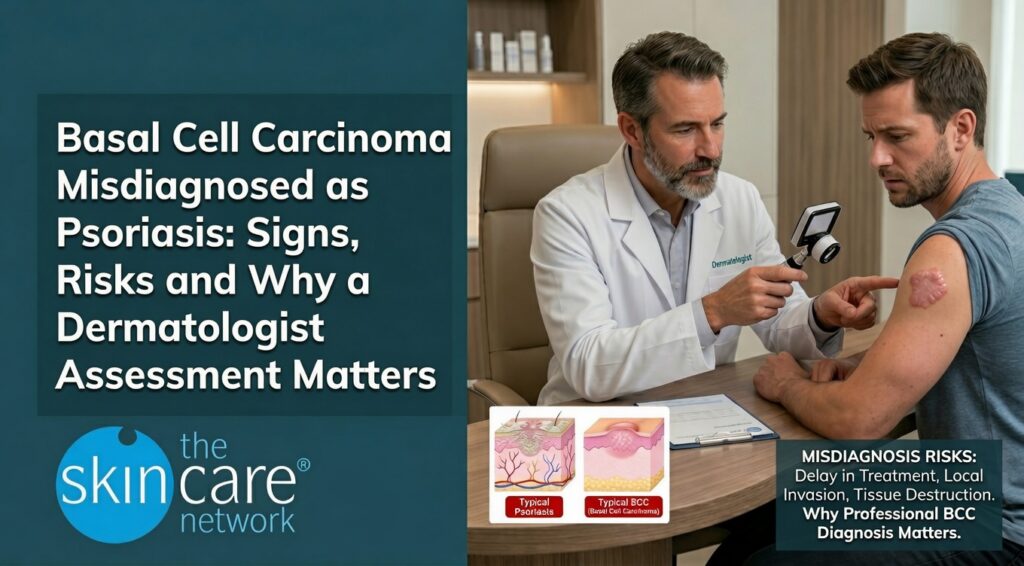
Basal Cell Carcinoma Misdiagnosed as Psoriasis: Signs, Risks and Why a Dermatologist Assessment Matters
“A UK patient lived with multiple basal cell carcinomas for 40 years after they were repeatedly misdiagnosed and treated as psoriasis, highlighting how superficial BCCs can closely mimic common skin conditions.”
Persistent red, scaly patches on the skin are often assumed to be psoriasis, but in some cases they may be basal cell carcinoma (BCC), the most common form of skin cancer. Early recognition and accurate diagnosis by a Dermatologist can prevent unnecessary delays and more extensive treatment.
Key Areas We Will Cover
- What basal cell carcinoma is and why it is frequently misdiagnosed as psoriasis
- Key differences between superficial BCC and plaque psoriasis
- Warning signs that warrant a Dermatologist review
- Risks of delayed diagnosis and potential complications
- The role of dermoscopy and biopsy in accurate diagnosis
- Prevention, early detection and professional care options in the UK
Introduction
Basal cell carcinoma (BCC) is the most common skin cancer in the UK, yet superficial forms can closely resemble non-cancerous conditions such as plaque psoriasis. This overlap can lead to misdiagnosis and prolonged inappropriate treatment. Understanding the differences and seeking expert evaluation is essential for timely intervention. At The Skin Care Network, our Dermatologist team provides thorough assessments to ensure accurate diagnosis and effective management of suspicious skin lesions.
What Is Basal Cell Carcinoma and Why Is It Often Misdiagnosed as Psoriasis?
Basal cell carcinoma is a slow-growing non-melanoma skin cancer with very low metastatic potential, but superficial BCCs can appear as flat, red, scaly plaques that closely mimic psoriasis, leading to years of incorrect treatment.
Superficial BCCs present as erythematous patches with scaling and well-defined borders, similar to chronic plaque psoriasis. In one documented case, multiple large superficial BCCs were treated as psoriasis for 40 years before correct diagnosis via biopsy. A Dermatologist uses clinical examination, dermoscopy and, when needed, biopsy to differentiate these conditions and avoid delays.
How Can You Tell the Difference Between Basal Cell Carcinoma and Psoriasis?
While both conditions can cause red, scaly patches, basal cell carcinoma often shows a pearly or raised border, central erosion, or specific dermoscopic features such as arborising telangiectasia, maple-leaf pigmentation and ovoid nests, which are not typical of psoriasis.
Psoriasis plaques are usually symmetrical, affect common sites like elbows and knees, and respond to topical treatments. BCC lesions may grow slowly, ulcerate, or fail to improve with standard psoriasis therapies. If patches persist despite treatment, a Dermatologist evaluation is recommended to rule out skin cancer.
What Are the Risks of Misdiagnosing Basal Cell Carcinoma as Psoriasis?
Delayed diagnosis of basal cell carcinoma can result in larger lesions requiring more extensive surgery, increased risk of local tissue destruction, and, in rare cases, metastasis, which carries a poor prognosis.
Factors increasing metastasis risk include lesion size over 3–5 cm, depth, perineural invasion, and head/neck location. In the reported case, large abdominal and back lesions were successfully excised after decades of misdiagnosis, with no metastasis found on staging. Early Dermatologist intervention prevents such outcomes and minimises scarring.
When Should You See a Dermatologist for Suspected Skin Lesions?
See a Dermatologist promptly if you have persistent red, scaly patches that do not respond to prescribed treatments, show irregular borders, ulceration, or bleeding, or appear in areas of previous sun exposure.
Particularly important for individuals with fair skin (Fitzpatrick type I–II), history of sunburn, or multiple lesions. Dermoscopy allows non-invasive visualisation of characteristic BCC features, guiding the need for biopsy. At our Barnet clinic, we offer rapid assessment and advanced diagnostic tools.
Address: 68-70 Union St, Barnet EN5 4HZ, United Kingdom
Conclusion
Basal cell carcinoma can be easily mistaken for psoriasis due to overlapping clinical features, potentially leading to years of ineffective treatment and larger lesions. Recognising warning signs and obtaining a specialist opinion from a Dermatologist ensures accurate diagnosis and timely, effective management. Most BCCs are highly treatable when caught early, with excellent outcomes.
Get Started Today
Worried about persistent skin patches or possible misdiagnosed lesions? Book a consultation with a Dermatologist at The Skin Care Network for expert evaluation, dermoscopy and peace of mind.
📞 Call +44 20 8441 1043 or visit our clinic at 68-70 Union St, Barnet EN5 4HZ. Early detection protects your skin health.
Frequently Asked Questions
Yes. Superficial BCCs often resemble plaque psoriasis with red, scaly patches. A Dermatologist can differentiate them using dermoscopy and biopsy if needed.
Look for pearly nodules, central ulceration, raised borders, or non-healing patches. Lesions that bleed easily or fail to clear with psoriasis treatment should be checked promptly.
Diagnosis typically involves clinical examination, dermoscopy and confirmatory biopsy. A Dermatologist will assess lesion characteristics and recommend the most appropriate next steps.
BCC grows slowly and rarely spreads, but large or delayed lesions can cause significant local damage. Early treatment by a Dermatologist usually results in complete cure.
Protect skin with daily broad-spectrum SPF 50, avoid sunbeds, and perform regular self-exams. High-risk individuals should have annual skin checks with a Dermatologist.


